

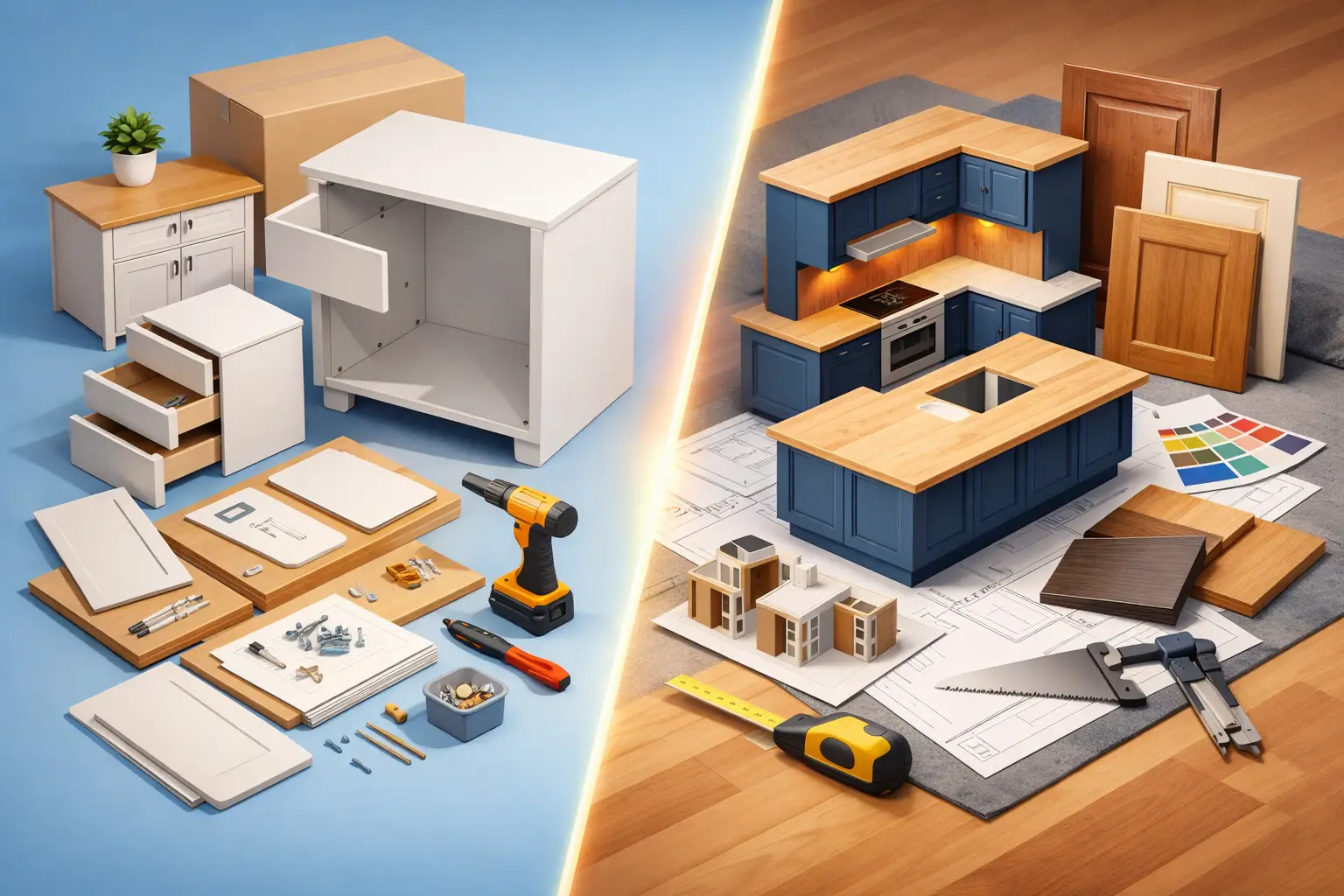

If you are planning a kitchen remodel, the rta cabinets vs custom decision usually comes down to one question: where do you want to spend your money? Most homeowners are not choosing between “cheap” and “high-end.” They are choosing between faster delivery and broader personalization, between strong value and fully one-off design, and between a practical remodel budget and a more open-ended investment.
That is why this comparison matters. Cabinets take up most of the visual space in a kitchen, but they also shape storage, workflow, and how long the room holds up under daily use. The right answer is not always custom. It is also not always RTA. It depends on your layout, your priorities, and whether your remodel needs true customization or simply better planning and better construction.
RTA cabinets vs custom: what is the difference?
RTA stands for ready-to-assemble. These cabinets are manufactured in standard sizes and shipped flat-packed for assembly and installation. That does not automatically mean low quality. Well-built RTA cabinets can include plywood boxes, dovetail drawers, soft-close hardware, and durable finishes that perform well in busy family kitchens.
Custom cabinets are built specifically for your kitchen, usually to exact dimensions and with broader options for materials, finish colors, storage features, and design details. They are made to solve unique layout conditions or match a very specific design vision.
The real difference is not just assembly. It is the degree of flexibility built into the product from the start. RTA lines work within a defined catalog of sizes, styles, and accessories. Custom cabinetry starts with your space and builds outward.
Cost is usually the first deciding factor
For most homeowners, price is where the conversation starts, and fairly so. Cabinetry is one of the largest line items in a kitchen renovation. RTA cabinets typically cost less than custom because they are produced at scale, with standardized dimensions and fewer labor hours tied to fabrication.
That lower price point can make a major difference in how the total remodel budget is allocated. Choosing a strong RTA cabinet line may free up funds for quartz countertops, upgraded lighting, new flooring, or appliance replacement. In many kitchens, that creates a better overall result than putting too much of the budget into fully custom cabinetry and having to compromise elsewhere.
Custom cabinets cost more because they involve more design time, more shop labor, and more one-off production. Sometimes that added cost is justified. If your kitchen has unusual dimensions, difficult corners, low soffits, or a layout where every inch matters, custom cabinetry can improve storage and fit in ways standard sizing cannot.
Still, paying more only makes sense when the project truly benefits from it. If your kitchen can be designed well with standard cabinet sizes, custom may be more than you need.
Quality is not the same as cabinet category
One of the biggest misconceptions in kitchen remodeling is that custom always means better quality and RTA always means lower quality. In practice, quality depends on construction details, not just the label.
A well-made RTA cabinet can offer plywood cabinet boxes instead of particleboard, solid wood doors, dovetail drawer construction, full-extension drawer glides, and soft-close hinges. Those features matter in everyday use. They affect how the cabinets feel, how they age, and how they perform under the weight of cookware, dishes, and constant opening and closing.
Custom cabinets can certainly be excellent, but the range is wide. Some are exceptional. Some are simply expensive. Homeowners should look past the sales language and ask direct questions about box material, joinery, drawer construction, finish quality, and hardware.
This is where value-conscious remodeling becomes important. A thoughtfully selected RTA line can deliver the construction standards many homeowners want without pushing the project into luxury-level pricing.
Design flexibility: where custom has a clear advantage
Custom cabinetry wins on flexibility. If you want a very specific wood species, a rare paint color, unusual cabinet depths, a furniture-style island, or built-ins tailored to a difficult wall, custom gives you more room to get exactly what you want.
It is also the better option for kitchens with structural quirks. Older homes, uneven walls, unusual ceiling heights, or specialty storage requests sometimes require fabrication that standard lines cannot accommodate cleanly.
That said, many modern kitchens do not need full custom work to look polished. A good design plan using quality frameless RTA cabinets can create a sleek, contemporary result with efficient storage and a refined finish. In many remodels, design skill matters as much as cabinet category. A kitchen with standard-size cabinets can still feel tailored when the layout, fillers, panels, and installation are handled correctly.
So the better question is not “Do I want custom?” It is “Do I need custom to solve this kitchen properly?”
Timeline matters more than most homeowners expect
Cabinet lead time can affect your entire renovation schedule. RTA cabinets often have a faster turnaround than custom because they come from established product lines with existing manufacturing systems. That can be a major advantage if you want to keep your remodel moving and reduce the time your kitchen is out of service.
Custom cabinetry typically takes longer. There is more back-and-forth in design, more fabrication time, and sometimes more opportunity for production delays. If your project is tied to a move-in date, holiday deadline, or family schedule, timeline should be part of the decision, not an afterthought.
In active households, a shorter cabinet timeline can reduce stress. It can also make it easier to coordinate installation, countertops, backsplash work, and final punch-list items without extended downtime.
Installation can make or break either option
Even excellent cabinets can disappoint if the installation is poor. Doors look uneven, fillers are awkward, reveals are inconsistent, and the whole kitchen loses the clean finish homeowners expect.
This is especially important in the rta cabinets vs custom conversation because some people assume custom will automatically install better. It will not. Custom cabinets still rely on proper field measurements, planning, leveling, fastening, and finish work.
RTA cabinets also require care in assembly and installation. When handled by experienced professionals, they can look every bit as polished as more expensive alternatives. The key is having a remodeling team that understands layout planning, cabinet alignment, trim details, and how the cabinets fit into the larger renovation scope.
That full-project perspective matters. Cabinets do not exist in isolation. Their success depends on walls, flooring transitions, appliance spacing, countertop templating, and other trades being coordinated correctly.
When RTA cabinets make the most sense
RTA is often the right choice when your kitchen has a relatively standard footprint, your budget matters, and you want dependable quality without overbuilding the project. It is a strong fit for homeowners who care about appearance and durability but do not need every cabinet made from scratch.
This option also makes sense when the goal is to maximize value. Many South Florida homeowners want a kitchen that looks elevated and functions better without entering ultra-custom pricing territory. In that situation, quality frameless RTA cabinetry can be a smart middle ground – modern in style, efficient in storage, and more disciplined in cost.
When custom is worth paying for
Custom is worth serious consideration when your kitchen has unusual constraints, when storage needs are highly specialized, or when the design intent cannot be achieved through a standard cabinet catalog. If exact sizing will noticeably improve function or visual balance, custom may earn its premium.
It can also be the better path for homeowners who are very particular about finish details and are willing to invest more time and money to get them. There is nothing wrong with that. The point is simply to be clear about whether you are paying for a real need or for options you may never use.
The better choice is the one that fits the whole remodel
Cabinets should not be chosen in a vacuum. The smartest decision usually comes from looking at the entire renovation together: layout changes, countertop material, appliance package, labor costs, and how long you plan to stay in the home.
For many homeowners, the strongest result comes from selecting high-quality RTA cabinets and pairing them with thoughtful design and professional installation. That approach can deliver the clean look, durable construction, and day-to-day function people want while keeping the project financially grounded. Leonardo’s Kitchens often sees this firsthand in practical remodels where homeowners want premium aesthetics without paying for unnecessary customization.
If your kitchen truly calls for custom work, it should be because the space demands it or the design justifies it. If not, there is real value in choosing cabinetry that performs well, looks refined, and leaves room in the budget for the rest of the renovation to come together properly.
The best cabinet decision is rarely the most expensive one. It is the one that gives you a kitchen that works better every morning, holds up year after year, and feels like money well spent.
