

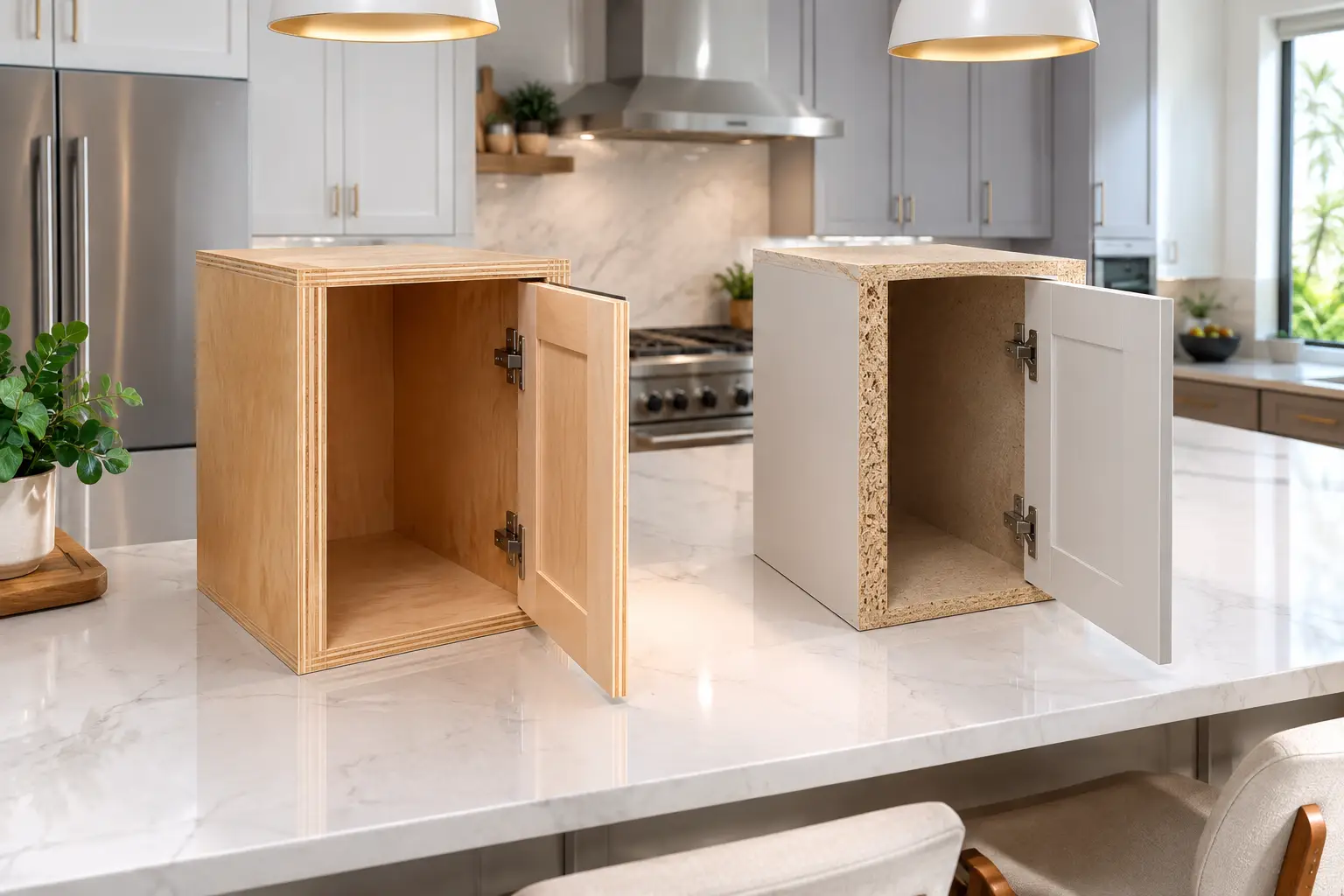

A cabinet door may be what you see every day, but the cabinet box is what carries the weight of your dishes, supports the countertop, and absorbs years of opening and closing. So, do plywood cabinets last longer? In most kitchens, quality plywood cabinet boxes have a clear advantage over particleboard in moisture resistance, screw-holding strength, and long-term durability. But the material label alone does not guarantee a better cabinet.
For Broward County homeowners planning a kitchen remodel, the better question is not simply plywood versus particleboard. It is whether the cabinet construction, finish, hardware, and installation are appropriate for how your household uses the kitchen – and for South Florida’s humidity.
Do plywood cabinets last longer in real kitchens?
Generally, yes. Plywood is made from thin layers of wood veneer bonded together with the grain alternating from layer to layer. That cross-layer construction gives it strength and stability without making it excessively heavy. When used for cabinet sides, bottoms, backs, and shelves, plywood is better equipped to handle a busy kitchen’s daily demands.
Particleboard is made from wood particles and resin pressed into sheets. It can be smooth, uniform, and cost-effective, which is why it appears in many cabinet lines. Its weakness is that it is more vulnerable when exposed to water. Once unprotected particleboard absorbs moisture, it can swell, lose density, and become less reliable at holding screws.
That distinction matters around a sink base, dishwasher, refrigerator water line, and any location where a small leak might go unnoticed. Plywood is not waterproof, and standing water can damage any wood-based cabinet. Still, it tends to tolerate brief moisture exposure better than standard particleboard and is less likely to break down as quickly.
Why cabinet construction matters as much as material
A well-built plywood cabinet can serve a family for decades. A poorly made plywood cabinet can still disappoint. The same is true in reverse: a well-designed particleboard cabinet with a durable finish, proper edge protection, quality hardware, and professional installation may perform well for many years in a dry, carefully maintained kitchen.
The cabinet box should be evaluated as a complete system. Look beyond the door style and ask how the sides and back are joined, whether the base is adequately supported, and how shelves are constructed. Thicker material and solid joinery help cabinet boxes remain square under the weight of cookware, appliances, and stone countertops.
Hardware also plays a major role. Soft-close hinges and full-extension drawer glides improve the daily experience, but they need a stable mounting surface. Plywood’s superior screw-holding ability is especially useful for heavily used drawers, pull-out organizers, and doors that are opened dozens of times a day. When hinges loosen in lower-density material, repeated tightening can eventually create a larger problem.
Plywood’s practical advantages
The strongest case for plywood is not that it makes a kitchen look better. Once cabinet doors are closed, plywood and particleboard boxes may look identical. Its value is in performance where homeowners cannot always see it.
Plywood typically provides better resistance to sagging on long shelves, especially when shelves hold stacks of plates, small appliances, or pantry items. It is also lighter than many particleboard panels of comparable thickness, which can make cabinet handling and installation more manageable without sacrificing structural strength.
It also performs well with fasteners. Cabinet installation requires secure anchoring, and the construction must support doors, drawers, and countertop loads for the long term. A quality plywood box gives installers a dependable substrate for those critical connection points.
For homeowners choosing between affordable RTA wood cabinets and a less expensive cabinet option, plywood construction often represents a worthwhile step up when the budget allows. The goal is not to pay for a feature that will never matter. It is to invest where the kitchen sees real stress: wet areas, active storage, and moving hardware.
Where particleboard can still make sense
Particleboard is not automatically a poor choice. Premium frameless cabinet systems often use engineered panels because they are exceptionally flat and provide a clean, consistent surface for modern finishes. In a frameless design, panel precision matters for door alignment and the streamlined appearance homeowners want.
The deciding factor is quality. Higher-density engineered panels with durable laminate or melamine surfaces and properly sealed edges can be suitable for many kitchen applications. A homeowner who wants modern frameless cabinets on a controlled budget may find that a well-made engineered cabinet line delivers the look, storage configuration, and reliable performance they need.
However, it makes sense to be selective. If a cabinet line uses particleboard, ask what protects the panel edges, how the sink cabinet is constructed, and whether the hardware is designed for the cabinet’s intended load. A cabinet’s weakest exposed edge can be more important than the broad, finished panels visible in a showroom.
Humidity, leaks, and South Florida kitchen conditions
Broward County homes deal with humidity for much of the year, even when air conditioning keeps indoor conditions comfortable. Humidity alone will not ruin good cabinets, but it raises the value of careful material selection and installation. Cabinets should be protected from plumbing leaks, dishwasher steam, and water that collects at the sink base.
The sink cabinet deserves special attention because it is the most common location for water damage. Whether you select plywood or engineered construction, a durable interior finish and prompt leak repair are essential. Check supply lines periodically, avoid storing wet cleaning materials directly on the cabinet floor, and address dishwasher leaks before they affect adjacent panels.
Cabinet finishes matter, too. A properly applied painted, stained, laminate, or thermofoil finish helps protect the underlying material from normal splashes and everyday cleaning. It is not a substitute for addressing water exposure, but it is part of the cabinet’s long-term defense.
How long should quality plywood cabinets last?
With good construction, professional installation, and reasonable care, plywood cabinets can remain structurally sound for 20 years or longer. Doors and drawer fronts may eventually need adjustment, hardware may wear, and a changing design preference may prompt an update before the boxes fail. Those are different issues from the cabinet structure itself reaching the end of its useful life.
A cabinet’s lifespan depends on its use. A household that cooks frequently, stores heavy cookware, and has children opening and closing every drawer will place more demand on the cabinetry than a lightly used kitchen. Wide drawers, trash pull-outs, and pantry storage all benefit from strong box material, solid drawer construction, and properly rated glides.
Countertop selection can add to the load. Quartz countertops are durable and attractive, but they are also heavy. Cabinet bases must be level, properly supported, and installed with care so the countertop has a stable foundation. This is one reason kitchen remodeling decisions should be coordinated rather than made one product at a time.
What to ask before buying cabinets
When comparing cabinet estimates, ask which components are plywood and which are engineered wood. Some cabinet lines use plywood sides and shelves but an engineered back panel. Others reserve plywood for upgraded boxes. Neither arrangement should be judged without considering thickness, finish, joinery, and the manufacturer’s overall construction standards.
It is also useful to ask about the drawer box material, shelf thickness, hinge quality, glide type, and sink-base protection. These details reveal more about everyday durability than a door color or a promotional label.
A professional kitchen design also helps avoid practical problems that shorten cabinet life. Proper spacing around appliances, correctly sized drawers for heavy items, and a layout that does not force doors to collide all reduce unnecessary wear. Leonardo’s Kitchens helps homeowners compare cabinet construction with their actual layout, budget, countertop choice, and installation requirements before the order is placed.
Choosing value, not just a label
Plywood is usually the stronger long-term cabinet-box material, particularly for active kitchens and moisture-prone areas. Yet the best purchase is not always the cabinet with the most plywood listed on a specification sheet. It is the cabinet line that combines sound materials, durable finishes, reliable hardware, and a design that fits your home and budget.
Before making a final decision, bring your cabinet questions into the design conversation. Seeing the construction details alongside a 3D kitchen plan makes it much easier to choose the right level of durability for the way you live.
