

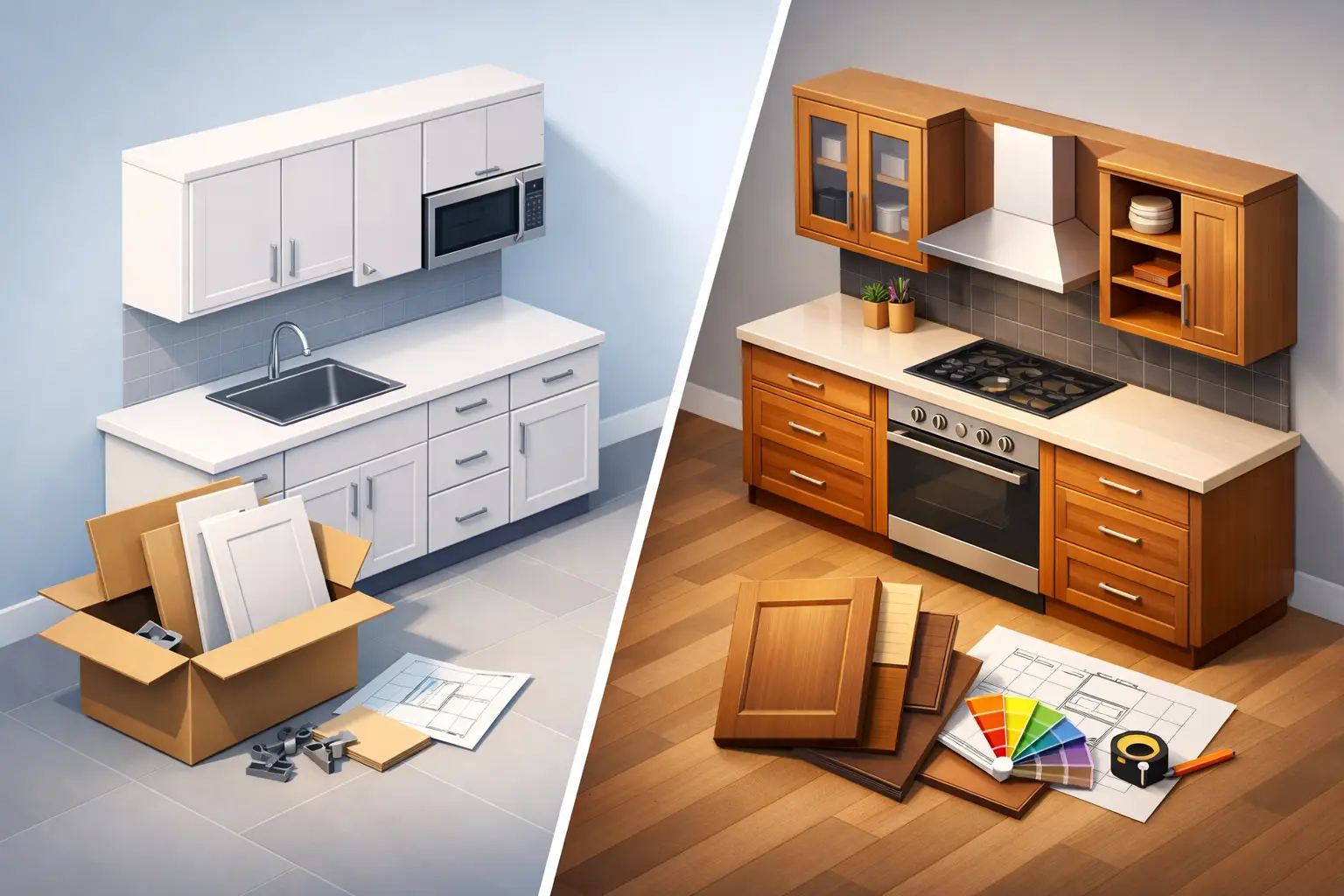

A kitchen remodel usually feels straightforward until cabinet decisions start affecting everything else – layout, budget, storage, and even how long the project stays under construction. When homeowners compare stock vs custom kitchen cabinets, they are really deciding how much flexibility they need, how much they want to spend, and where quality matters most.
For many kitchens, the right answer is not the most expensive option. It is the cabinet solution that fits the room, supports the way the household cooks and stores items, and delivers a finished look that feels intentional. That is why this decision deserves a closer look than a simple price comparison.
Stock vs Custom Kitchen Cabinets: The Core Difference
Stock cabinets are built in standard sizes, standard configurations, and a limited range of finishes. They are designed for faster ordering and simpler installation because the manufacturer has already set the dimensions and style options. If your kitchen layout is fairly typical and your priorities are speed and cost control, stock cabinets can make a lot of sense.
Custom cabinets are built specifically for your kitchen. Width, height, depth, finish, wood species, door style, storage accessories, and specialty details can all be tailored to the space. That flexibility is the main reason custom cabinetry costs more. You are paying for design freedom, fabrication time, and a more exact fit.
There is also an in-between category that many homeowners find appealing: semi-custom. While this article focuses on stock vs custom kitchen cabinets, it is worth noting that semi-custom often gives homeowners a better balance of price and personalization than either extreme.
Cost Is Important, but It Should Not Be the Only Measure
Stock cabinets usually win on upfront price. Because they are mass produced, manufacturers can keep costs lower and delivery times shorter. If your goal is to update an outdated kitchen without stretching the remodeling budget too far, stock cabinetry can help you put more of your investment toward countertops, appliances, lighting, or flooring.
Custom cabinets carry a higher price tag because they involve more labor, more design coordination, and more material choices. In some kitchens, that extra cost is justified. If the room has unusual walls, low bulkheads, tricky corners, or a layout where every inch matters, custom work may prevent wasted space and reduce compromises.
The key question is not just, “Which costs less?” It is, “What am I getting for the difference?” A lower cabinet price does not always mean better overall value if the result leaves gaps, filler panels, awkward storage, or a design that still feels unfinished.
Fit and Layout Usually Decide the Best Direction
This is where the real trade-off shows up. Stock cabinets work best when the kitchen can accept standard sizes without too much adjustment. In a simple L-shaped or galley kitchen, that can be completely fine. Installers can often use fillers and trim pieces to create a clean final look.
But some kitchens are less forgiving. Older homes, walls that are out of square, unusual ceiling heights, and appliance placements that do not align with standard cabinet modules can all make stock cabinetry feel limiting. In those cases, custom cabinets allow the design to follow the room instead of forcing the room to work around prebuilt sizes.
That matters for function as much as appearance. A narrow area that could become a tray cabinet, spice pull-out, or deeper drawer bank may be wasted if standard sizes do not fit well. When homeowners are already investing in a remodel, losing usable storage can feel like a missed opportunity.
How Quality Varies in Stock and Custom Cabinets
Many people assume stock means lower quality and custom means better quality. Sometimes that is true, but not always.
Cabinet quality depends more on construction details than on category alone. Box material, joinery, drawer construction, hardware, finish quality, and door stability all matter. A well-made stock cabinet with plywood boxes, dovetail drawers, and soft-close hardware can outperform a poorly made custom cabinet built with weaker materials.
That is why homeowners should look past labels. Ask what the cabinet box is made from. Check whether drawers are solid wood or particleboard. Ask about hinge and glide quality. Review finish durability, especially in a kitchen where heat, moisture, and daily use are constant factors.
For homeowners who want an upgraded look without paying for full custom fabrication, this is often the sweet spot. Good stock or semi-custom frameless cabinets can deliver a clean, modern appearance and strong everyday performance if the construction is right.
Style Options and Design Freedom
Custom cabinets offer the widest design range, and that can be valuable if you have a very specific vision. You can adjust door proportions, request unique paint colors, increase cabinet depth, take cabinetry to the ceiling, or build around unusual architectural conditions. If the kitchen is part of a larger design statement, custom can support that level of control.
Stock cabinets are more limited, but limited does not automatically mean inadequate. Many homeowners are not looking for one-of-a-kind detailing. They want a polished kitchen with attractive finishes, practical storage, and a layout that feels current. If the available door styles and colors align with your goals, stock cabinets may meet the design need without the custom price.
This is especially true in contemporary kitchens, where simpler lines often carry the design. A well-selected frameless cabinet in the right finish can look refined and expensive even when it is not fully custom.
Timeline Matters More Than People Expect
Cabinets affect the pace of the whole remodel. Stock cabinets are usually available faster, which can help keep the project moving. That shorter lead time can be a major advantage for homeowners trying to limit disruption, especially if the kitchen is the center of daily family activity.
Custom cabinets take longer because they must be designed, approved, fabricated, finished, and delivered. If the project schedule is flexible, that may not be a problem. But if you are coordinating multiple trades or trying to complete a renovation by a certain date, the longer wait should be part of the decision.
In active remodeling markets like South Florida, scheduling windows matter. Delays in cabinetry can affect countertop templating, appliance installation, backsplash work, and final punch-list items.
When Stock Cabinets Make the Most Sense
Stock cabinets are often the right choice when the kitchen has a fairly standard footprint, the homeowner wants predictable pricing, and the goal is a strong visual and functional improvement without overbuilding for the home. They are also a smart option when budget discipline matters and the selected product line still offers solid construction features.
For many remodels, this is the practical path. You can achieve a clean, elegant kitchen without paying for customization that the space may not actually require.
When Custom Cabinets Are Worth It
Custom cabinets tend to make sense when the kitchen has unusual dimensions, storage needs are highly specific, or the homeowner wants a tailored look that standard sizing cannot deliver. They are also worth considering when the remodel involves a major layout redesign and cabinetry is central to making the plan work.
That does not mean custom is automatically better. It means the added flexibility solves real problems. If those problems are not present, the extra expense may not improve the result enough to justify the cost.
A Better Question Than Stock or Custom
For many homeowners, the smartest question is not simply stock vs custom kitchen cabinets. It is this: what cabinet level gives me the best combination of fit, durability, appearance, and value for this specific kitchen?
That is where experienced design guidance matters. A good cabinet plan should account for room dimensions, workflow, storage habits, finish preferences, and installation realities. It should also be honest about where custom details will make a difference and where they will not.
At Leonardo’s Kitchens, that conversation often leads homeowners toward value-focused solutions with better construction details than they expected – not because every project needs the highest cabinet tier, but because every project benefits from the right one.
If you are comparing options for your own remodel, look beyond the label and focus on how the cabinets will perform once the kitchen is in daily use. The best choice is the one that makes the room feel well planned, well built, and worth the investment every time you open a drawer.
