

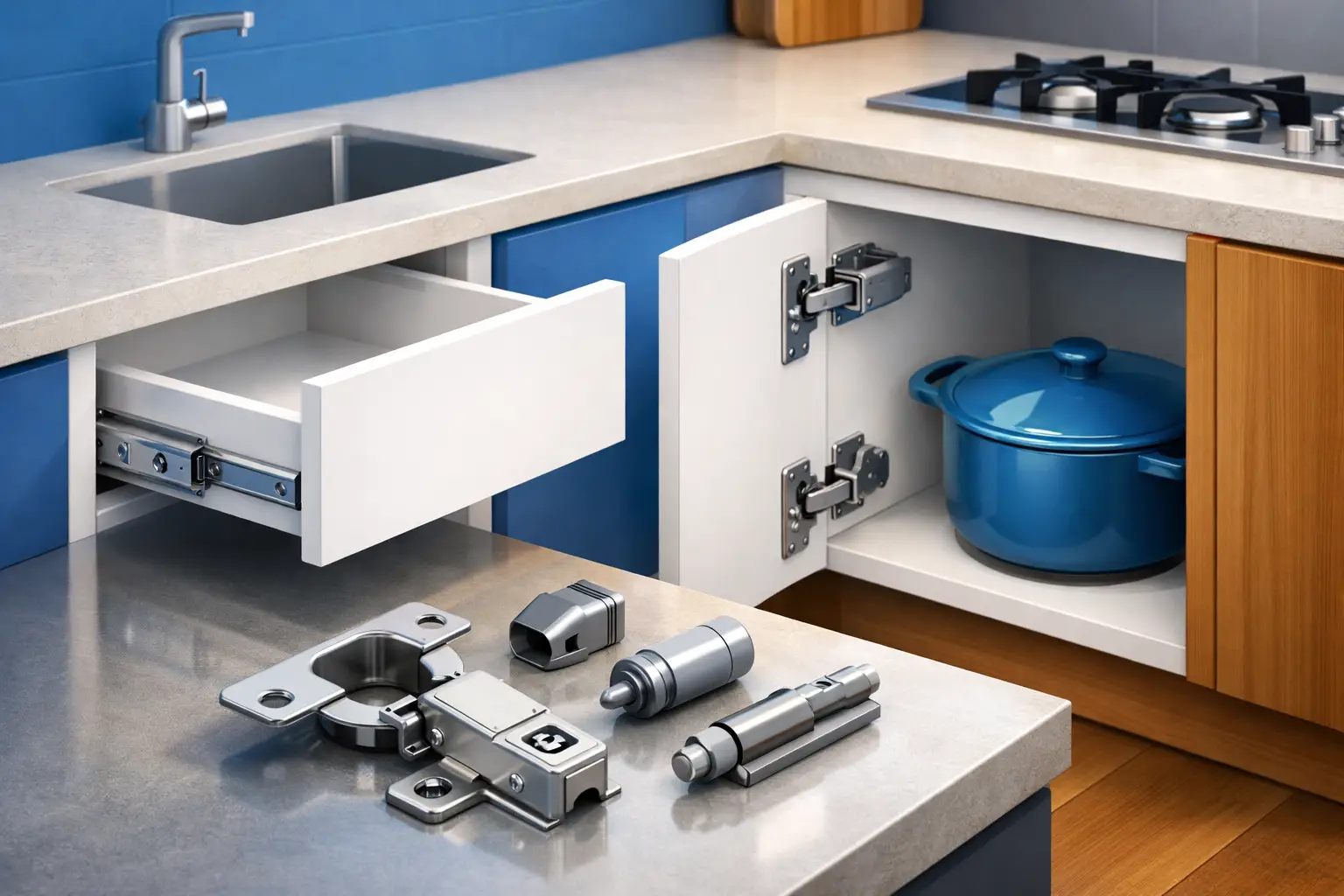

A kitchen can have beautiful doors, durable countertops, and a well-planned layout, yet still feel disappointing when drawers slam and cabinet doors bounce shut. The best soft close cabinet hardware solves that everyday frustration with a controlled, quiet motion that protects cabinets from repeated impact. For a homeowner planning a kitchen renovation, it is one of the construction details worth evaluating before cabinets are ordered.
Soft-close hardware is not simply a luxury add-on. Quality hinges and drawer slides improve the daily experience of the kitchen, help preserve door and drawer alignment, and support the refined feel homeowners expect from a modern cabinet installation. The right choice depends on the cabinet style, drawer size, intended use, and how carefully the system is installed.
What Makes Soft-Close Hardware Worth the Cost?
Soft-close hardware uses a damper to catch a door or drawer near the end of its travel and bring it closed gradually. A properly operating hinge keeps a cabinet door from striking the frame. A quality slide prevents a loaded drawer from crashing into the cabinet box. The result is quieter operation, but the benefit goes beyond noise reduction.
Repeated slamming transfers force into cabinet doors, drawer fronts, screws, mounting plates, and cabinet boxes. Over time, that impact can contribute to loose hardware, shifting reveals, chipped finishes, and doors that no longer sit evenly. Soft-close mechanisms reduce that stress during the part of the motion that causes the most wear.
For families, the feature also makes the kitchen more forgiving. A child can push a drawer closed too hard without the usual bang. Someone unloading dishes late at night can work more quietly. These are small improvements, but kitchens are used many times a day, and small annoyances add up quickly.
Best Soft Close Cabinet Hardware Starts With the Cabinet Type
Hardware should never be selected separately from the cabinet construction. Frameless cabinets, often called European-style cabinets, use a different hinge and mounting approach than face-frame cabinets. Since frameless cabinetry has no front frame around the opening, hinge placement, overlay, and adjustment range are especially important for achieving clean, consistent gaps between doors.
For most frameless kitchen cabinets, concealed soft-close cup hinges are the preferred solution. The hinge body is hidden when the door is closed, preserving the clean lines of a contemporary kitchen. Many models offer three-way adjustment, allowing the installer to move the door up or down, side to side, and in or out. That adjustment matters after installation, when walls, floors, and cabinet boxes may not be perfectly square.
Drawer hardware also needs to fit the cabinet system. Undermount soft-close slides are often the strongest visual choice because they are installed beneath the drawer and remain hidden when the drawer is open. They provide a more polished appearance than side-mounted slides and typically offer smoother operation. They also require drawers built to precise dimensions, which is one reason cabinet quality and installation experience matter.
Side-mount ball-bearing slides can still be a practical option in certain applications. They may cost less and are commonly used for utility drawers or cabinets where the hardware will not be a design focal point. However, visible side slides generally do not provide the same refined look as a good undermount system.
Hinges: Look Beyond the Soft-Close Label
Not every soft-close hinge performs the same way. A low-cost hinge may close slowly when the door is empty and properly aligned but struggle with a tall pantry door, a heavy wood door, or a door that has been adjusted poorly. Better hinges use more dependable dampers, stronger mounting components, and more precise adjustment mechanisms.
When comparing hinges, focus on the door application. Standard cabinet doors need a hinge designed for their overlay and opening angle. Blind-corner doors, corner cabinets, and pantry units may require specialty hinges. A 110-degree opening is common for everyday base and wall cabinets, while wider-angle hinges can be helpful where access inside the cabinet is a priority.
Soft-close hinges also need to be matched to door weight. Some premium hinges allow the damper strength to be adjusted or switched off for very light doors. Without this control, a lightweight door can close too slowly or fail to pull itself fully shut. On the other hand, a large, heavy door may need additional hinges to prevent sagging and maintain a controlled close.
The practical lesson is simple: the best hinge is not just the one with a soft-close feature. It is the one correctly specified for the door, cabinet layout, and expected use.
Drawer Slides: Capacity, Extension, and Drawer Construction
Drawer slides do more work than most homeowners realize. A kitchen drawer may hold utensils and linens, but it may also carry stacks of dishes, cooking tools, pantry goods, or heavy pots. The slide must support that weight while opening smoothly and closing under control.
For frequently used kitchen drawers, full-extension soft-close undermount slides are usually the most useful choice. Full extension allows the drawer to pull out far enough for clear access to the back. This is particularly valuable in deep base cabinets, where a partial-extension drawer can leave useful storage difficult to reach.
Weight rating deserves close attention. A standard rating may be sufficient for cutlery and everyday storage, but wide drawers holding cookware often need a higher-capacity slide. The drawer box itself must support the load as well. Plywood drawer construction and dovetail joints provide a stronger foundation than thin particleboard boxes joined with staples or light fasteners.
A quality slide cannot compensate for a weak drawer box, and a well-built drawer cannot perform properly on poorly fitted slides. These parts work as a system. That is why cabinetry should be judged by the box material, drawer construction, and installed hardware together rather than by a single advertised feature.
How to Compare Hardware Quality Before Buying
Brand names can be useful indicators, but the specification and installation are more meaningful than a logo alone. Homeowners should ask the cabinet provider clear questions about the hardware included with the cabinet package.
Consider these four details when comparing options:
- Adjustment range: Hinges with reliable three-way adjustment make it easier to maintain even door spacing after installation and through normal seasonal movement.
- Slide extension and capacity: Confirm whether drawers are full extension and whether the load rating suits cookware, dishes, and larger pull-out storage.
- Finish and corrosion resistance: Hardware should have a durable finish, especially in South Florida homes where humidity can be a concern.
- Replacement availability: Established hardware systems are easier to service if a hinge, clip, or slide is damaged years later.
It is also reasonable to test a sample. Open the drawer fully, place moderate pressure on it, and close it with a normal push. A good soft-close drawer should move smoothly without rattling, stop consistently, and close completely. Test a door from different positions as well. It should not require a hard push to engage the damper or remain slightly open after closing.
Installation Is Where Good Hardware Proves Itself
Even premium hardware can feel mediocre if it is installed without care. Cabinet boxes must be level, plumb, and securely fastened. Drawer slides need to be parallel and set at the exact required height. Hinges need proper cup placement, secure mounting plates, and final adjustment after all doors are hung.
This is especially relevant in remodels. Existing floors and walls are not always level, and a new cabinet run may meet an uneven wall or an out-of-square corner. Skilled installation accounts for those conditions before the doors and drawers are adjusted. Rushing this process can leave homeowners with rubbing doors, inconsistent gaps, or drawers that do not close properly.
Hardware should also be checked after the kitchen has settled into use. A minor adjustment may be needed after several months, particularly on heavily used doors or wide drawers. This is normal maintenance, not a sign that the cabinets are failing.
Where It Makes Sense to Spend More
If the renovation budget requires choices, prioritize soft-close hardware on the cabinets and drawers used most often: trash pull-outs, cookware drawers, pantry pull-outs, and the main sink-area cabinets. These locations see the highest daily traffic and benefit most from dependable slides and hinges.
Less frequently used specialty storage may be a reasonable place to select a more basic configuration, provided the hardware still fits correctly and carries the needed load. The goal is not to pay for the most expensive component in every location. It is to build a kitchen where the visible details and daily-use functions hold up well over time.
At Leonardo’s Kitchens, soft-close hardware is considered alongside cabinet construction, layout, and installation rather than treated as an isolated upgrade. When door style, drawer box quality, and hardware are specified together, homeowners can invest confidently in a kitchen that looks polished and works quietly long after the remodel is complete.
Before finalizing a cabinet order, open the drawers, test the doors, and ask what hardware is actually included. Those few minutes of hands-on evaluation can help you choose a kitchen that feels as good to use on year five as it does on installation day.
