

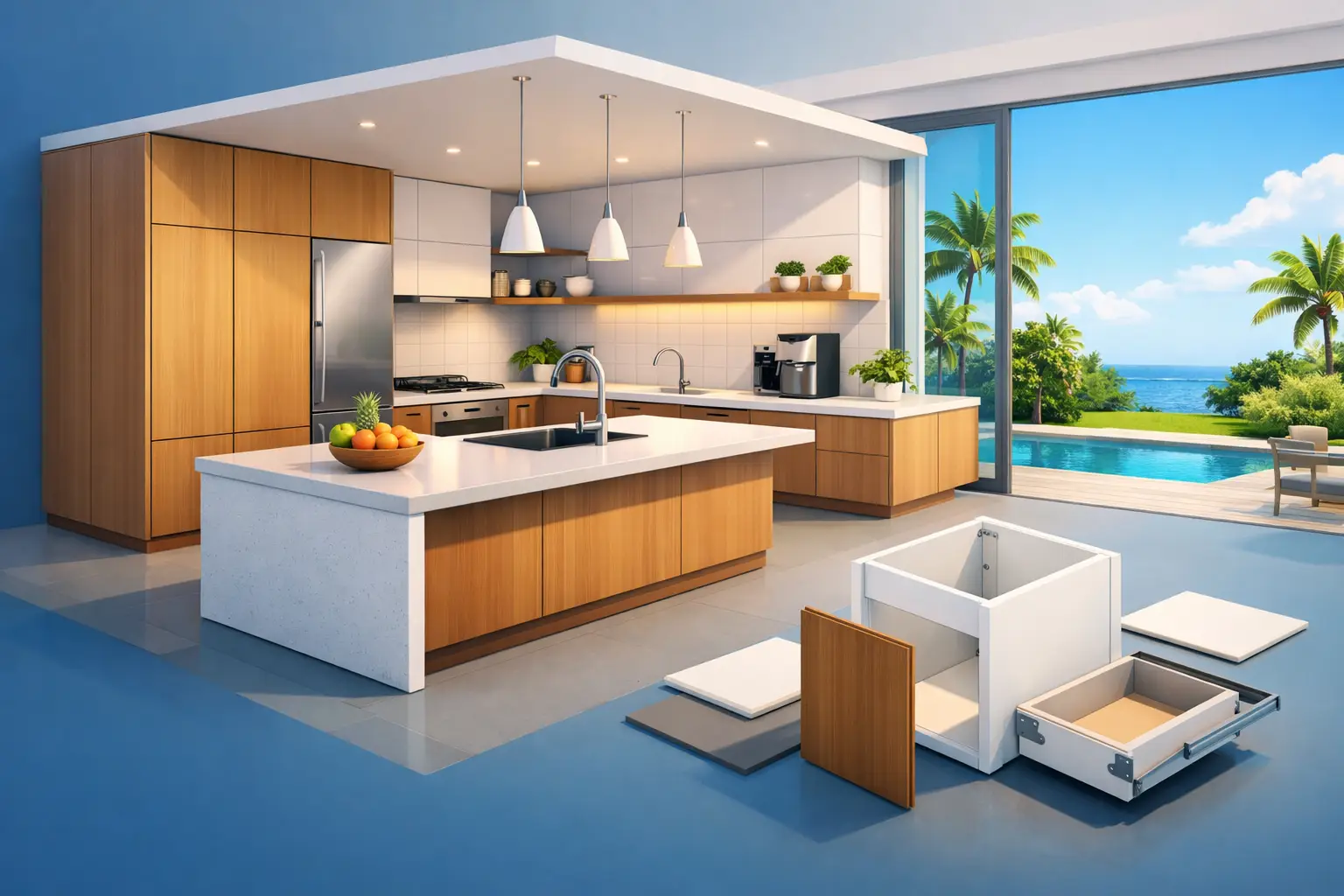

A frameless kitchen cabinets review should answer more than whether the doors look modern. For a homeowner planning a remodel, the real questions are whether the cabinets will hold up, make better use of the available space, fit the budget, and be installed precisely enough to look as good in five years as they do on day one.
Frameless cabinets can be an excellent choice for South Florida kitchens because they offer a clean appearance, generous interior storage, and flexible design options. Their value, however, depends heavily on the cabinet box material, drawer construction, hardware, and installation. Two frameless cabinet lines can look similar in a showroom while delivering very different long-term performance.
What Makes Frameless Cabinets Different?
Traditional face-frame cabinets have a solid wood frame attached to the front of the cabinet box. That frame adds structure, but it also creates a visible border around cabinet openings. Frameless cabinets, often called European-style cabinets, use a thicker cabinet box without that front frame. Doors and drawer fronts attach directly to the sides of the box.
The result is a more streamlined, contemporary look with tight, consistent reveals between doors and drawers. It also creates wider cabinet openings. Without a face frame taking up space at the front, you gain more usable room for pots, pantry items, dishes, and pull-out organizers.
This construction is particularly appealing in smaller or inefficient kitchens. A few extra inches of accessible storage across several base cabinets can reduce countertop clutter and make an older kitchen work much better without expanding its footprint.
Frameless Kitchen Cabinets Review: Construction Matters Most
The word “frameless” describes a cabinet style, not a quality level. A cabinet can be frameless and still be built with thin particleboard, weak drawer slides, or limited adjustment options. Before comparing door colors or cabinet prices, look closely at what is behind the doors.
Plywood boxes offer meaningful value
Cabinet boxes carry the weight of countertops, cookware, dishes, and daily use. Plywood boxes are generally a stronger option than basic particleboard construction, particularly around screw connections, hinges, and drawer-slide mounting points. Quality plywood also handles the normal humidity changes of a South Florida home better than low-grade engineered materials.
That does not mean every particleboard cabinet will fail. Higher-density furniture board can perform adequately in a dry, well-maintained kitchen. Still, for a remodel intended to last, plywood cabinet boxes are a practical upgrade worth considering. They provide a stronger foundation without automatically pushing a project into custom-cabinet pricing.
Dovetail drawers are a useful quality signal
Open a drawer and inspect how it is joined. Dovetail drawer construction uses interlocking wood joints at the corners, creating a durable connection that resists pulling apart under load. It is a better detail than stapled or lightly glued drawer boxes, especially for wide drawers used for cookware or dishes.
The drawer bottom also matters. A thin bottom can bow when loaded with plates or heavy utensils. A well-built drawer should feel solid, glide smoothly, and sit squarely in the opening when fully extended.
Soft-close hardware improves daily use
Soft-close hinges and drawer slides are now expected in a quality kitchen, but not all hardware performs the same way. Good hardware closes quietly, holds door alignment, and gives drawers a controlled, steady motion. Lesser hardware may start with a soft-close feature but lose adjustment or become inconsistent after repeated use.
Ask what brand and type of hardware is included, whether drawers are full extension, and whether hinges can be adjusted after installation. These small details affect how the kitchen feels every day and make future service easier.
The Advantages Homeowners Notice
Frameless cabinets are popular for good reason. Their full-overlay doors create a polished wall-to-wall appearance, especially with flat-panel, shaker, slab, or modern wood-grain door styles. The look can feel tailored without requiring fully custom cabinetry.
Storage is another major advantage. Wider openings make it easier to use rollout trays, waste pullouts, deep drawer bases, and pantry organizers. In a kitchen with limited square footage, replacing a bank of narrow doors with practical drawer storage can have a bigger impact than adding more cabinets.
Frameless construction also supports design flexibility. Homeowners can choose a warm wood finish, a clean white shaker profile, or a darker contemporary palette while keeping the same efficient cabinet platform. When paired with thoughtful lighting, countertops, and a well-planned backsplash, frameless cabinetry can make an outdated kitchen feel significantly more current.
For a remodel with a defined budget, this style often provides a strong middle ground: more refined than many entry-level cabinet options, yet more attainable than a fully custom shop-built kitchen.
Trade-Offs to Consider Before Buying
A balanced frameless kitchen cabinets review should also address the limitations. Because doors attach directly to the cabinet box, installation accuracy is critical. Small leveling errors can create uneven gaps, rubbing doors, or drawer fronts that do not line up. Proper shimming, fastening, and final hinge adjustment are not optional details.
Frameless cabinets also rely on the strength of their box panels. This is why material thickness and construction methods matter. A properly built plywood cabinet with reliable hardware can serve a busy family kitchen very well. A lower-quality box may be more susceptible to damage around hinges or fasteners over time.
Style preference is another consideration. Some homeowners prefer the traditional character and visible craftsmanship of face-frame cabinetry. Frameless cabinets have a cleaner, more continuous appearance, which suits many transitional and modern designs but may not match every home.
Finally, cabinet sizing needs to be planned carefully. Stock and RTA frameless lines usually offer a useful range of widths and specialty units, but they are not infinitely customizable. Fillers, panels, and design adjustments may be needed to achieve a finished look around walls, appliances, or uneven corners. Good kitchen design makes those necessary pieces look intentional rather than like an afterthought.
Why Installation Can Make or Break the Result
Cabinets are only as dependable as the installation beneath them. Floors and walls are rarely perfectly level or square, especially in existing homes. An experienced installer accounts for those conditions before countertops are measured and before door alignment is finalized.
The work begins with a verified layout. Cabinet locations must accommodate appliance clearances, plumbing, electrical outlets, ventilation, and countertop overhangs. Base cabinets need to be leveled and securely fastened. Wall cabinets need solid support and accurate alignment so door gaps remain consistent from one end of the kitchen to the other.
This is one reason a cabinet purchase with design and installation support can be easier to manage than buying cabinets from one source and coordinating multiple trades independently. The cabinet plan, field measurements, installation requirements, and finish details should all support the same result.
For homeowners in Weston, Davie, Miramar, Southwest Ranches, and Pembroke Pines, a local remodeling team also understands the practical realities of working in occupied homes, condominium requirements, and regional project schedules. That coordination can prevent expensive corrections later in the project.
How to Compare Frameless Cabinet Quotes Fairly
A low cabinet quote can be attractive, but it is only useful if it includes the construction and services you actually need. Compare the cabinet box material, door material, drawer construction, hinges, slides, finish options, panels, trim, fillers, delivery, assembly, and installation scope.
It is also wise to ask whether the design includes functional storage where it counts. A quote with fewer cabinets may be a better value if it uses deep drawers, a practical pantry solution, and properly sized cabinets around the range and refrigerator. Conversely, a low price can rise quickly when essential panels, hardware upgrades, and installation corrections are added afterward.
At Leonardo’s Kitchens, the goal is to help homeowners weigh those details before committing to a layout or finish. Affordable cabinetry should still have the construction features that make a kitchen comfortable to use and dependable over time.
The best choice is not simply the least expensive frameless cabinet or the most elaborate one. It is the cabinet system that fits your layout, includes materials you can trust, and is installed with enough care that every drawer, door, and countertop line feels right when you use the kitchen each morning.
