

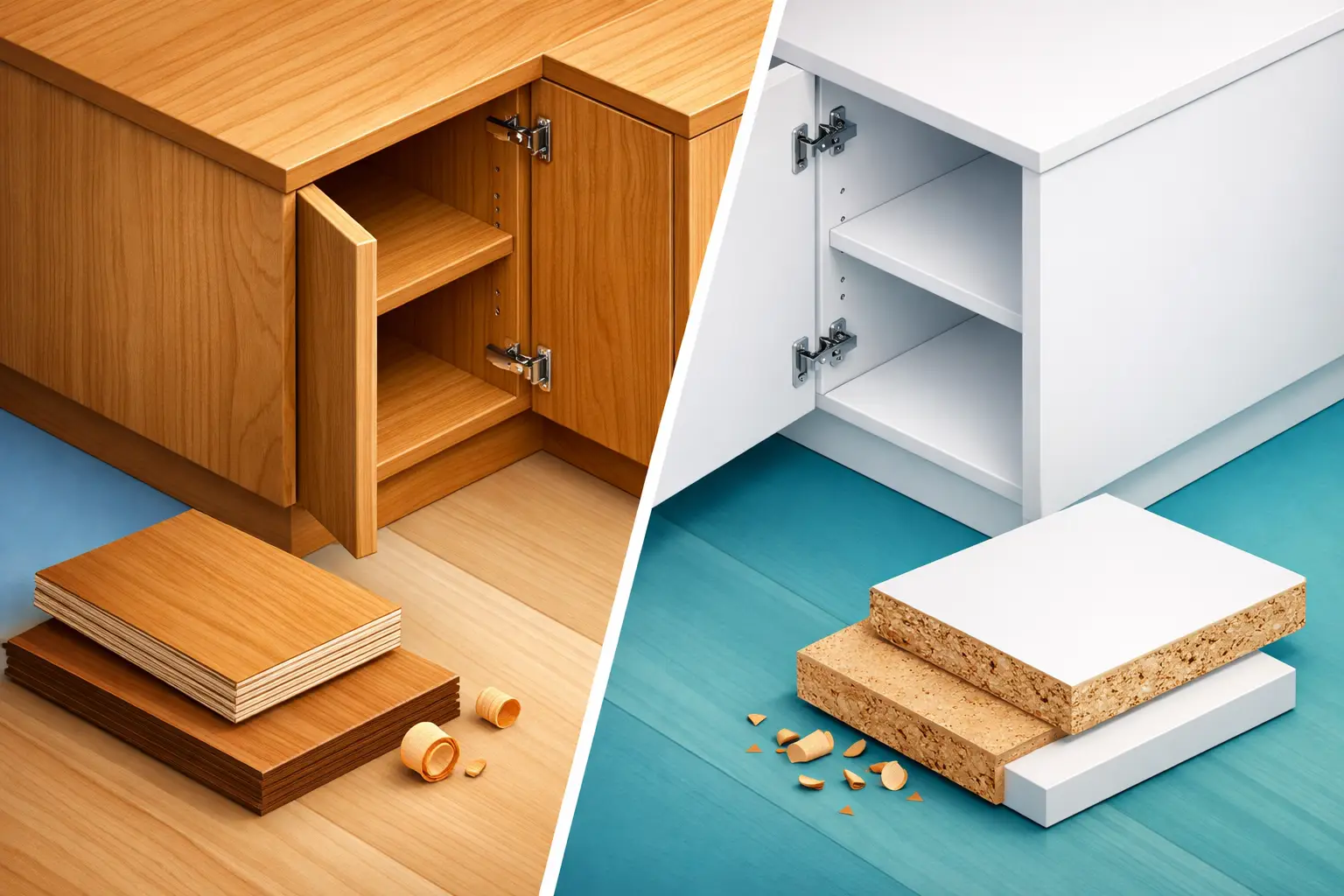

If you are comparing plywood cabinets vs particleboard, you are already asking the right question. Cabinet doors and finishes get most of the attention in a showroom, but the cabinet box is what carries the weight, handles daily use, and determines how well your kitchen holds up over time. For homeowners planning a remodel, this choice affects durability, cost, and how confident you feel about the investment.
In kitchen remodeling, material decisions should be practical. A cabinet may look beautiful on day one, but if shelves sag, screws loosen, or moisture causes swelling around the sink base, the lower upfront price stops looking like a bargain. That is why the difference between plywood and particleboard matters.
Plywood cabinets vs particleboard: what is the actual difference?
Plywood is made from thin layers of wood veneer glued together in alternating grain directions. That cross-layered construction gives it strength and stability. In cabinet boxes, plywood is widely considered an upgrade because it resists warping, holds fasteners well, and performs better under repeated use.
Particleboard is made from wood particles and resin compressed into sheets. It is flatter and less expensive to produce, which is why it appears in many budget cabinet lines and mass-market products. It can perform adequately in the right setting, but it is generally less durable than plywood when exposed to heavy loads, moisture, or years of wear.
This does not mean every particleboard cabinet is automatically poor quality, or that every plywood cabinet is premium in every respect. Construction details still matter. Drawer joinery, hardware, back panel thickness, and installation quality all play a role. But when you isolate the cabinet box material itself, plywood has meaningful advantages.
Why material matters so much in a kitchen
A kitchen is a demanding environment. Cabinets support stacks of dishes, cookware, small appliances, and pantry items. They also deal with humidity, spills, steam, cleaning products, and constant opening and closing. Sink bases are especially vulnerable, and areas near the dishwasher can also take on moisture over time.
Plywood handles these conditions better because it is structurally stronger and less likely to break down if minor moisture exposure occurs. Particleboard is more vulnerable to swelling when water penetrates the surface or edges. Once that swelling happens, the damage is usually permanent.
For a guest bathroom vanity or a low-use laundry area, the trade-off may be easier to accept. In a busy family kitchen, especially one intended to last for many years, the difference becomes more significant.
Strength and screw holding
One of the biggest practical advantages of plywood is how well it holds screws. Cabinets rely on screws at multiple points, from box assembly to hinges, drawer slides, and installation attachment. When a material grips fasteners securely, the cabinet tends to stay tighter and more stable over time.
Particleboard can be more brittle around screws, especially after repeated adjustments or stress. If hardware loosens or has to be reinstalled, the material is more likely to strip out. That matters in real life because kitchen hardware does not stay untouched forever. Hinges may need alignment, drawer slides may be replaced, and cabinets may endure years of use by children, guests, and everyday cooking routines.
Plywood is not indestructible, but it gives installers and homeowners a better margin for long-term performance.
Moisture resistance is where plywood usually pulls ahead
Homeowners often focus on style first, then budget, then layout. Moisture resistance should be much higher on the priority list than many people realize. Kitchens in South Florida deal with humidity before you even get to sink splashes or dishwasher steam.
Plywood is not waterproof, but it generally tolerates occasional moisture better than particleboard. If a small leak happens under the sink and is caught quickly, plywood is more likely to remain serviceable. Particleboard tends to absorb water faster, swell, and lose structural integrity.
This is one of the strongest arguments for plywood cabinet boxes in kitchens. You are not just buying appearance. You are buying more forgiveness in a room where water is always nearby.
Cost: where particleboard earns its place
The main reason particleboard remains common is simple. It costs less. For homeowners trying to keep a remodel within a strict budget, that lower price can make a project possible.
There are situations where particleboard may be a reasonable compromise. A lower-use kitchen, a short-term ownership plan, or a very budget-sensitive renovation can all shift the decision. Some well-manufactured particleboard cabinets with quality laminate or melamine finishes can still look attractive and function well for years if they are not exposed to abuse or moisture problems.
That said, the lowest cabinet price is not always the lowest total value. If a homeowner expects to stay in the home, wants a more durable result, or simply does not want to question the cabinet box every time there is a plumbing issue, plywood often justifies its added cost.
Plywood cabinets vs particleboard for long-term value
When clients compare cabinet estimates, the pricing difference can feel very immediate, while the construction difference can feel abstract. The better question is not just, “Which one is cheaper today?” It is, “Which one gives me fewer problems over the next ten years?”
Plywood generally wins that conversation. It holds up better under weight, manages moisture more gracefully, and gives better support for hardware and installation. Those benefits may not be obvious from across the room, but they matter every day once the kitchen is in use.
This is especially relevant in remodels where homeowners are also investing in countertops, backsplash, lighting, and labor. Saving some money on the cabinet box material may not feel like a strong win if the rest of the kitchen is being built to a higher standard.
Appearance is not the deciding factor
From the outside, many homeowners cannot tell whether a cabinet box is plywood or particleboard. The visible finish, door style, color, and hardware influence the look far more than the core box material. That is why material quality can be overlooked so easily during shopping.
What you are really paying for with plywood is not better looks. You are paying for better performance behind the scenes. In a kitchen remodel, some of the smartest decisions are the ones you do not notice every day because they simply keep working.
When particleboard may still make sense
There is no value in pretending every project needs the highest upgrade in every category. Some remodels are driven by resale timing, rental budgeting, or strict financial constraints. In those cases, particleboard may help a homeowner reach a design goal without overextending the budget.
It can also make sense when the cabinet line is otherwise well designed and the homeowner understands the trade-offs. If the kitchen is unlikely to see heavy wear and the project budget is tight, directing funds toward better layout, improved storage, or professional installation may be the smarter move.
The key is transparency. A homeowner should know exactly what they are buying and why it costs what it costs.
What to ask before choosing cabinet construction
When evaluating cabinets, ask what the box material is, how thick the panels are, what the back panel construction looks like, and whether the drawers are dovetail with soft-close hardware. Ask how the cabinets will be installed and whether the quote reflects long-term durability or just entry-level pricing.
A trustworthy kitchen company should be able to explain not only what material is used, but why that choice matters for your project. For many homeowners, especially those planning a full kitchen upgrade rather than a quick cosmetic change, plywood cabinet boxes offer a better balance of quality and cost than people expect.
That is one reason companies like Leonardo’s Kitchens emphasize plywood construction details alongside design and installation. Homeowners are not only buying cabinets. They are buying confidence in how the finished kitchen will perform.
The better choice depends on your goals
If your priority is the lowest possible upfront price, particleboard will usually have appeal. If your priority is durability, moisture resistance, and stronger long-term value, plywood is usually the better cabinet box material.
For most primary kitchens, plywood is the safer investment. It supports the kind of daily use that makes or breaks satisfaction after a remodel is finished. Not every project needs top-tier everything, but cabinet box construction is one of the areas where paying attention tends to pay off.
Before choosing based on door style or finish alone, take a closer look at what is underneath. The right kitchen should not just look refined on installation day. It should still feel solid after years of cooking, cleaning, and real life.
