

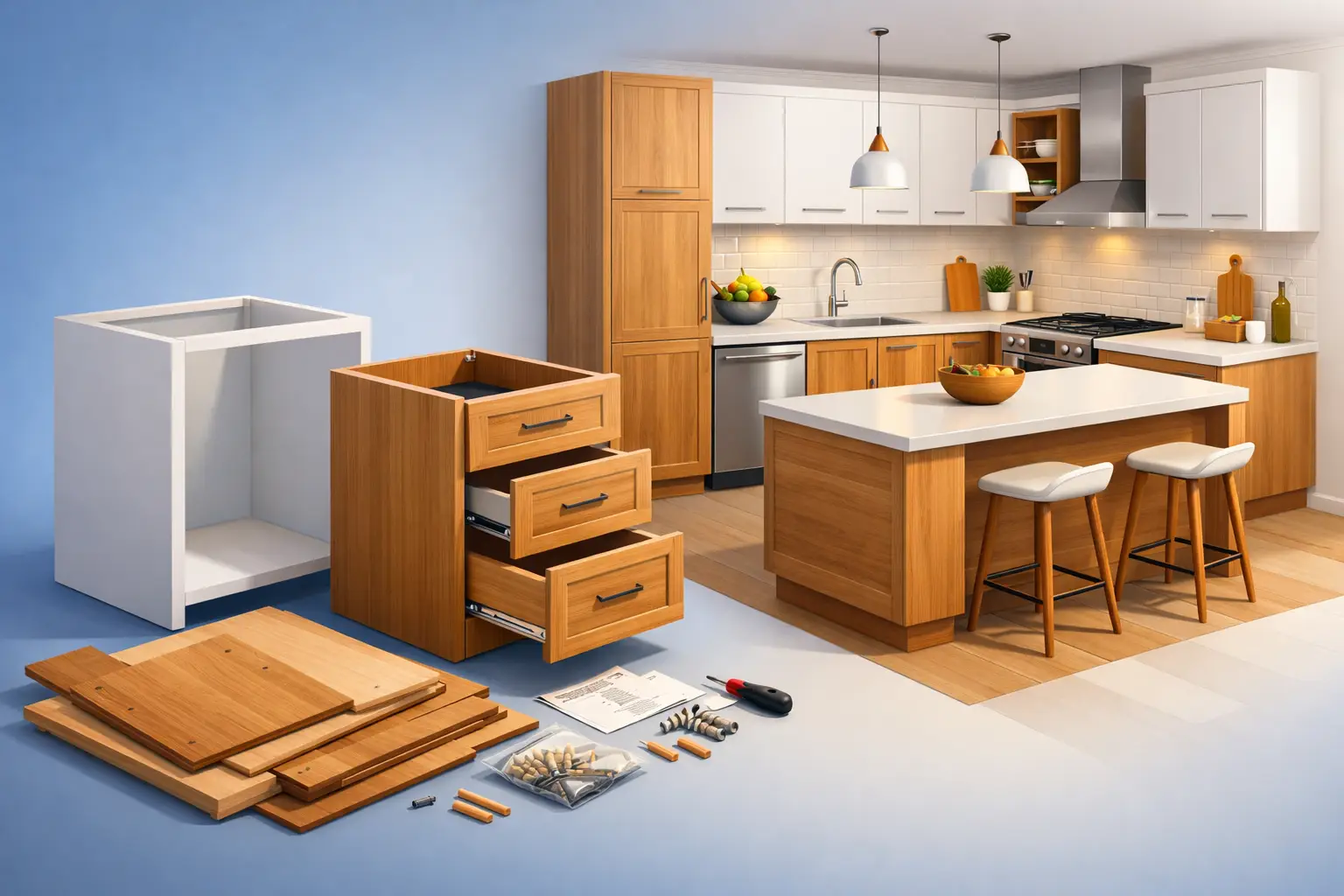

If you are planning a kitchen remodel, one question tends to come up fast: are RTA wood cabinets good enough for a space you use every day? It is a fair question, especially when cabinet pricing ranges from surprisingly affordable to shockingly high. The short answer is yes – RTA wood cabinets can be very good. The better answer is that their quality depends on how they are built, what materials are used, and who is handling the design and installation.
For many homeowners, RTA cabinets make sense because they can lower costs without forcing a cheap look. But there is a big difference between a well-made RTA cabinet with plywood construction and soft-close hardware, and a low-end option made with weak materials and limited support. If you are comparing cabinet options for a kitchen upgrade, the details matter more than the label.
What does RTA actually mean?
RTA stands for ready to assemble. That means the cabinets arrive flat-packed and are assembled before installation rather than delivered fully built from the factory.
That packaging method affects shipping and handling costs, which is one reason RTA cabinets are often more affordable than pre-assembled cabinetry. It does not automatically mean the cabinets are lower quality. Assembly style and construction quality are two different things, and they should be evaluated separately.
A cabinet can be RTA and still include plywood cabinet boxes, dovetail drawer construction, solid wood doors, and durable soft-close hinges. On the other hand, a cabinet can be pre-assembled and still cut corners in materials. Homeowners sometimes assume assembled means premium, but that is not always true.
Are RTA wood cabinets good when you compare construction?
They can be, especially when you focus on how the cabinet is built instead of how it ships.
The first thing to look at is the cabinet box. Plywood is generally a stronger and more moisture-resistant choice than particleboard, which matters in a kitchen where humidity, spills, and daily use are constant. If an RTA cabinet line uses plywood sides and a solid, well-engineered back panel, that is a strong sign you are looking at a better product.
Drawer construction is another clue. Dovetail drawers usually indicate a higher level of craftsmanship than stapled or thin-panel drawers. Soft-close slides and hinges also improve daily function and reduce wear over time. These are not just nice extras. They affect how the kitchen feels to use every day.
Door material matters too. Solid wood doors tend to perform better than low-grade alternatives, especially in kitchens where heat and moisture can cause expansion and contraction. A quality finish also helps protect the cabinet surface from staining, peeling, or early wear.
So, are RTA wood cabinets good? Yes, if the construction details are right. No, if the product relies on weak materials to hit a low price point.
Why homeowners choose RTA cabinets
Cost is the obvious reason, but it is not the only one.
RTA cabinetry often gives homeowners access to better-looking finishes and stronger construction at a more practical price. Instead of paying more for factory assembly and higher freight costs, that budget can go toward upgraded materials, more functional storage, or a broader remodel scope.
That matters in real kitchen projects. Many homeowners are not just replacing cabinets. They are updating countertops, improving layout, changing lighting, or coordinating flooring and backsplash work at the same time. Saving money on cabinetry without giving up quality can make the rest of the remodel easier to manage.
There is also a style advantage. Today’s RTA cabinet lines often include clean, modern profiles that work well in South Florida homes, especially for homeowners who want a refined frameless look without stepping into custom-cabinet pricing.
Where RTA cabinets can fall short
This is where the trade-offs need to be clear.
The biggest risk with RTA cabinets is inconsistency. Some lines are excellent. Others are built to look good online but do not hold up under daily use. Thin side panels, poor joinery, weak drawer hardware, and low-quality finishes can all show up in lower-end products.
Assembly quality also matters. Even a good cabinet can perform poorly if it is assembled incorrectly. Squareness, fastener placement, panel alignment, and hardware installation all affect long-term durability. In a kitchen remodel, cabinet problems rarely stay small. A door that sits unevenly, a drawer that binds, or a box that shifts out of level can create headaches during countertop installation and final finishing.
There is also the issue of planning. RTA cabinet projects benefit from accurate measurements, smart filler use, and a layout that accounts for appliance clearances and workflow. If a homeowner tries to manage everything without guidance, the savings can disappear quickly through ordering mistakes or installation delays.
What makes an RTA wood cabinet worth buying?
A worthwhile cabinet usually checks a few specific boxes. It should have a plywood box or at least upgraded structural panels, solid wood or quality engineered door components, dovetail drawers, soft-close hardware, and a finish that feels consistent and durable.
But product specs are only part of the equation. The company behind the cabinets matters just as much. A knowledgeable supplier or remodeling partner can help you avoid sizing errors, layout issues, and mismatched expectations around lead times or finish appearance. That support is often what separates a smooth remodel from a frustrating one.
This is especially true if you are balancing budget and appearance. A well-planned RTA kitchen can look polished and high-end when the design is handled properly. The wrong door style, poor spacing, or awkward cabinet placement will make even expensive materials feel underwhelming.
RTA vs. custom and pre-assembled cabinets
If you are deciding between cabinet categories, the answer usually comes down to budget, timeline, and how tailored the layout needs to be.
Custom cabinets offer the most flexibility. They are useful when a kitchen has unusual dimensions, complex design requirements, or highly specific finish goals. But custom work costs more, and that premium is not necessary for every home.
Pre-assembled cabinets reduce labor at the assembly stage, which can be helpful in some situations. However, they often cost more to ship and store, and they do not automatically offer better materials.
RTA wood cabinets often sit in a very practical middle ground. They can provide strong construction, attractive design, and better value for homeowners who want a major visual upgrade without paying for fully custom fabrication. For many kitchen remodels, that is the sweet spot.
Are RTA wood cabinets good for long-term use?
They can absolutely hold up for years if the materials and installation are right.
Daily performance depends on structural integrity, hardware quality, and how well the cabinets are installed into the space. Kitchens are hard-working rooms. Doors open constantly, drawers carry weight, and moisture is part of normal use. Cabinets built with plywood boxes and reliable hardware are far better equipped to handle that than low-cost alternatives.
Installation plays a major role here. Even a strong cabinet can wear unevenly if it is installed out of level or forced into a poor layout. That is why many homeowners prefer working with a remodeling company that can guide both the cabinet selection and the installation process. It reduces the guesswork and helps protect the investment.
For homeowners in areas like Weston, Davie, and Pembroke Pines, where kitchen updates often aim to improve both resale appeal and everyday function, this matters. A cabinet choice should not just look good on day one. It should continue to perform well after years of cooking, cleaning, and regular family use.
Who should consider RTA wood cabinets?
RTA wood cabinets are a strong option for homeowners who want a kitchen that looks upscale, functions well, and stays within a disciplined remodeling budget. They are especially appealing when you want better construction than many entry-level stock cabinets but do not need the price tag of full custom work.
They are also a smart fit when you value practical upgrades such as soft-close drawers, quality finishes, and efficient storage, and you want those features to fit into a broader remodel plan.
If you are expecting highly unusual dimensions, one-of-a-kind millwork details, or exact custom color matching, RTA may not be the right lane. But for many standard kitchen layouts, it offers a very solid balance of cost and quality.
Leonardo’s Kitchens works with homeowners who want that balance. The goal is not just to sell cabinets. It is to help create a kitchen that feels refined, works better, and makes financial sense.
A good kitchen remodel is rarely about choosing the most expensive option. It is about choosing materials and construction that give you the best return in daily use, appearance, and peace of mind. That is where quality RTA wood cabinets can earn their place.
