

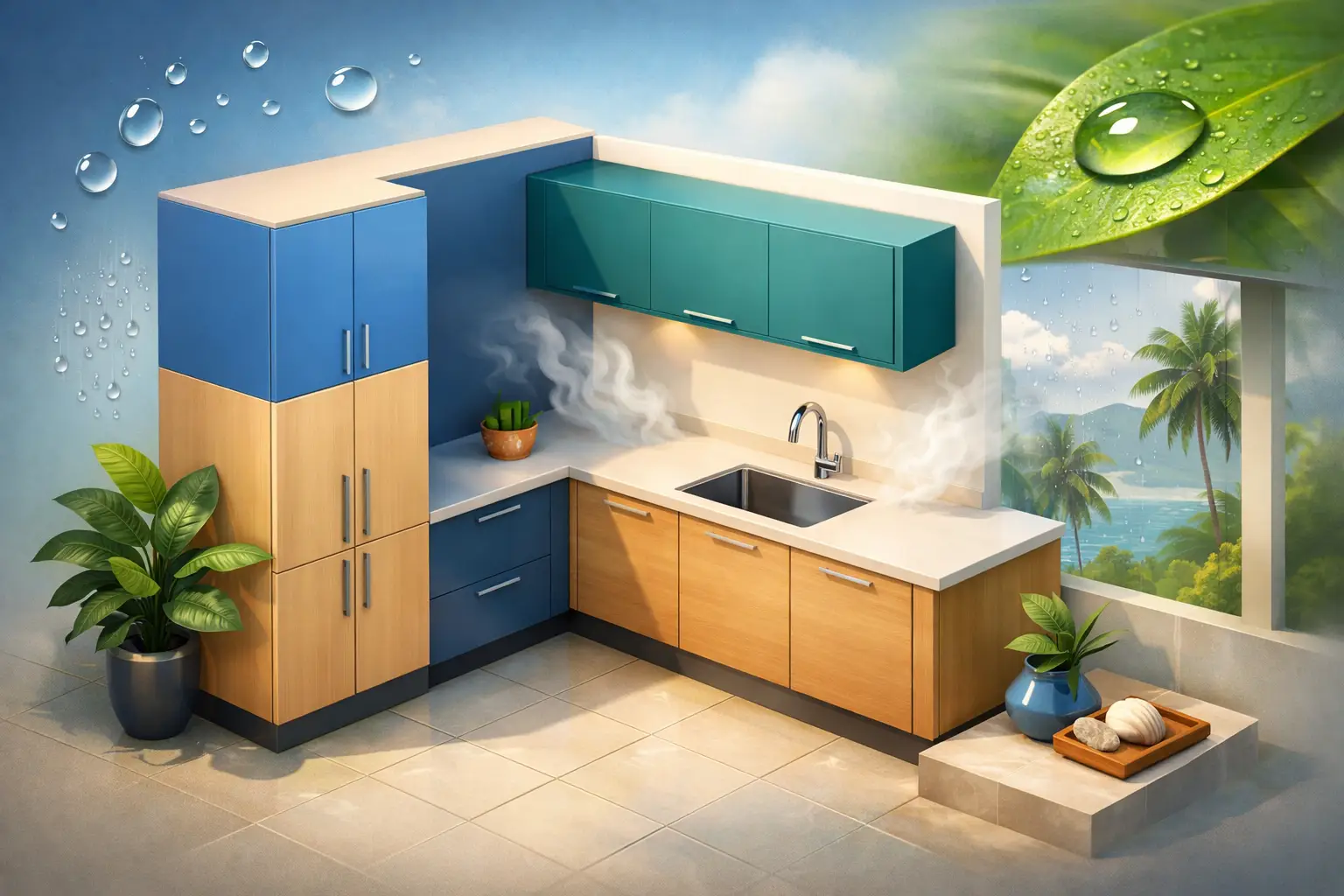

If your kitchen air feels sticky half the year, your cabinets notice it before you do. The best cabinets for humid climates are not just about style – they are about choosing materials, finishes, and construction details that resist swelling, warping, peeling, and premature wear. In places like South Florida, where heat and moisture are part of daily life, that choice can make the difference between a kitchen that stays sharp for years and one that starts showing problems much sooner than expected.
Humidity affects cabinets in predictable ways. Wood can expand and contract. Poor-quality panels can bow. Cheap thermofoil can loosen at the edges. Low-grade particleboard can absorb moisture and break down faster, especially around sinks, dishwashers, and cooktops. That is why cabinet selection in a humid climate should start with construction quality, not just door color or door style.
What makes the best cabinets for humid climates different?
The biggest difference is stability. In a dry climate, a wider range of cabinet materials may perform reasonably well. In a humid kitchen, weak points show up faster. Cabinet boxes, door cores, edge treatments, and finishes all matter more because moisture has more opportunities to get in.
Plywood cabinet boxes are usually one of the strongest choices. Quality plywood handles moisture better than basic particleboard because it has layered wood veneers that provide better structural stability. That does not mean every plywood cabinet is automatically superior, but a well-built plywood box generally gives homeowners a more dependable foundation in a humid environment.
Solid wood doors can also perform well, especially when they are properly finished and built with room for natural movement. But this is where nuance matters. Wood is attractive and durable, yet it still reacts to moisture. A poorly made solid wood door may expand or shift more than a well-made engineered door with a strong finish. The better question is not whether wood is good or bad. It is whether the cabinet is engineered for real kitchen conditions.
Best cabinet materials for humid climates
For most homeowners, the safest choice is a cabinet with a plywood box, durable door construction, and a finish designed for kitchen use. This combination tends to offer the best balance of longevity, appearance, and value.
Plywood cabinet boxes
Plywood is often the preferred cabinet box material in humid climates because it is more moisture-resistant than standard particleboard or low-end fiberboard. It is less likely to sag or deteriorate when exposed to the everyday humidity swings of a busy kitchen. If there is a dishwasher nearby, a sink base that gets occasional splashes, or a floor that may experience some moisture during cleaning, plywood offers extra peace of mind.
That said, plywood is not indestructible. If water is allowed to sit for long periods, even quality plywood can suffer damage. Humidity resistance is not the same as waterproof performance. Good material still needs proper use and proper installation.
Solid wood doors
Solid wood remains a strong option when quality is high. It brings a refined look and can last for many years, but it needs a stable environment and a quality finish. In humid climates, well-made shaker or slab doors in hardwood species can perform well, especially when paired with reliable joinery and finishing.
The trade-off is cost and movement. Solid wood generally costs more, and minor seasonal expansion is normal. That does not mean homeowners should avoid it. It just means they should expect craftsmanship to matter more than marketing language.
MDF for painted doors
Medium-density fiberboard, or MDF, is often used for painted cabinet doors because it provides a smooth surface and does not have the grain movement of natural wood. In some cases, MDF can actually be a smart choice for painted finishes in humid kitchens, especially when it is high quality and well sealed.
The caution is water exposure. MDF does not handle direct water intrusion as well as plywood. Around sinks or problem areas, poor sealing can become an issue. For homeowners who want a painted look, the key is not rejecting MDF automatically, but making sure the door and finish system are built for kitchen conditions and installed correctly.
Finishes matter as much as the cabinet material
One of the most common mistakes homeowners make is focusing only on the cabinet core and ignoring the finish. In humid climates, the finish acts as a protective layer. A durable painted, stained, or laminated surface helps slow moisture penetration and keeps doors and drawer fronts looking cleaner over time.
Painted cabinets can work very well, but the quality of the finishing process matters. A factory-applied finish tends to be more consistent and more durable than a quick field-applied coating. Stained wood finishes can also perform well because they often show less visible wear than painted surfaces, depending on the species and sheen.
Thermofoil deserves careful consideration. It can look clean and modern, and it is often budget-friendly, but in hot and humid kitchens, low-quality thermofoil is more prone to peeling, especially near heat-producing appliances. It is not always the best long-term bet for homeowners who want durability first.
Construction details that protect cabinets in moisture-prone kitchens
The best cabinets for humid climates are usually easy to recognize once you know what to look for. Beyond the box material, the construction details tell you whether the cabinet is built to last.
Look for full-depth backs or strong hanging rails, quality joinery, and dovetail drawer construction where possible. Soft-close hardware is not just a luxury feature – it reduces slamming and stress on doors and drawer fronts over time. Well-fitted hinges also help doors stay aligned when humidity causes minor movement in the surrounding materials.
Edge banding and sealed surfaces matter too. Exposed raw edges are weak points in a humid kitchen. Once moisture gets into those edges, swelling and breakdown can follow. A cabinet may look attractive in the showroom, but if the edges and interiors are not properly finished, performance can suffer in real use.
Why installation has so much to do with cabinet lifespan
Even excellent cabinets can underperform if they are installed poorly. In humid climates, installation quality matters because level alignment, spacing, sealing, and appliance fit all affect how the kitchen handles moisture over time.
Sink base cabinets are a good example. If plumbing cutouts are rough, unsealed, or oversized, that area becomes more vulnerable. If a dishwasher is installed without proper moisture protection, steam can repeatedly hit nearby cabinet surfaces. If cabinets are pushed too tightly into uneven conditions without careful adjustment, doors and drawers may start to bind as materials shift.
This is one reason many homeowners prefer working with a kitchen company that handles both cabinetry and installation. It reduces the disconnect between what was sold and how it performs after the remodel is complete. For kitchens in Weston, Davie, Miramar, Southwest Ranches, and Pembroke Pines, where humidity is part of everyday life, that coordination matters.
Style choices that work well in humid environments
Modern frameless cabinets can be a strong option in humid climates when they are built with quality materials and hardware. Their clean lines appeal to homeowners updating older kitchens, and because they maximize usable storage, they also support better kitchen function.
Slab and shaker styles are both practical choices. Simpler profiles are easier to clean, which helps in kitchens where moisture and cooking residue can build up more quickly. A polished design still matters, but in a climate with constant humidity, easy maintenance is part of long-term value.
Color also plays a role, though not for structural reasons. Lighter finishes may show grime less dramatically in some kitchens, while darker painted finishes can reveal more fingerprints and salt-air residue if the home is near the coast. This is not a reason to avoid a color you like, but it is worth considering if you want a kitchen that feels easier to maintain.
How to choose the right cabinet without overspending
The goal is not to buy the most expensive cabinet available. The goal is to avoid the weak points that fail first in humid conditions. For many homeowners, that means putting the budget into plywood cabinet boxes, dependable door construction, and quality installation rather than paying extra for features that do little for durability.
That value-focused approach is where many remodels go right. A well-built cabinet with practical upgrades often outperforms a flashy cabinet with weaker materials. At Leonardo’s Kitchens, that is a common conversation with homeowners who want an elegant result but also want confidence that their investment makes sense for the local climate.
If you are comparing options, ask direct questions. What is the box made from? Are the drawer boxes dovetailed? How are the doors finished? What protections are used around sink and dishwasher areas? A good cabinet supplier or remodeler should answer those questions clearly, not dodge them with vague promises.
The right cabinet for a humid climate is the one that balances appearance, construction quality, and installation discipline. If you get those three right, your kitchen has a much better chance of looking polished long after the remodel dust is gone.
